1912 In Review

1912 could be regarded as the ‘Titanic’ year of the 20th Century. All other international and Australian events were dwarfed in comparison with this epic maritime disaster resulting in the loss of 1500 lives.

Melbourne saw the price of milk raised to 5d a quart because of dearer feed to the horses. A bill was introduced in the Victorian House of Representatives for ₤5 a year maternity allowance for white women. Melbourne’s new amusement park, Luna Park was opened in St. Kilda and just down the bay at Geelong, the Hills Hoist rotary clothes line was invented. Continue reading

Portsea Camp Excursion

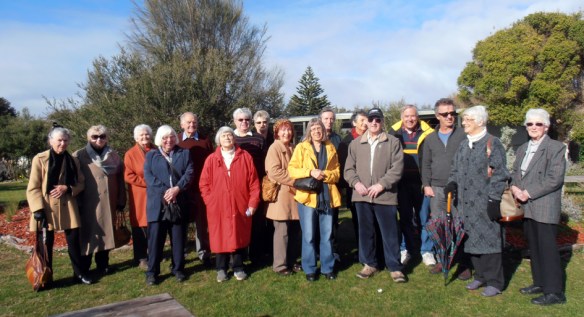
Members and friends of the NHS enjoyed a tour of the Portsea Camp with the CEO, Stephen Eastop, on 16th July.

Portsea Camp Visit

Portsea Camp Visit

The camp has a long history. Originally an aboriginal site, from the 1880s the area was used by the military.

There is still evidence of defence structures on the site.

It began as the Lord Mayor’s Camp for Country Children in 1946.

Doreen Parker

Hetty’s Purse

This touching little leather, coin purse worn so thin from use, with a corner mended with black cotton was recently re-discovered in a drawer in our Watts Cottage, Ilfracombe.

Volunteer Bergliot Dallas found it when she was spring cleaning. When she brought it in to show us we all gently stroked the soft leather – it is that sort of object.

Hetty Watts' Purse

Hetty Watts’ Purse

We know from its catalogue number that this purse was owned by the third youngest daughter and sixth child born to John Francis and Jane Watts in November 1878. Christened Harriet Maria she was always called Hetty (sometimes she spelt it Hettie.)

Hetty never married and we believe her sweetheart died in WWI.  Bergliot had earlier written an interpretation of Hetty’s life based around her precious notebook safely stored in our fire proof filing cabinet. You can read Bergliot’s moving piece in the Museum – it is one of our Treasures of the Museum booklets written by volunteers in 2010.

After her mother‘s death in 1935 Hetty lived on at Ilfracombe until 1958. She died in 1962 aged 84 and is buried in Sorrento Cemetery. Her little purse is on display now.

Joy Kitch

Collection Co-ordinator

A Mystery Jacket

A Mystery Tunic with a Famous Connection

Some questions regarding the tunic held in The Museum are being answered.
Royal Artilery Jacket

Royal Australian Artillery Tunic

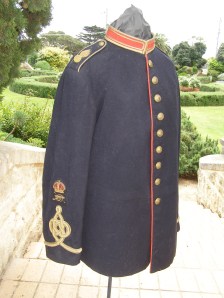
According to the Curator at Fort Queenscliff, Sgt Helen Janner, the uniform with the patrol style collar shows it is not from an Officer but a Non-commissioned officer or Other Rank’s. The sleeve insignia denotes the rank of a Warrant Officer class 2*, of Heavy Artillery (Coastal Artillery). And due to the brass buttons insignia, ‘Royal Australian Artillery’ it is of pre world war 1 circa. She thinks perhaps around 1908. It is either The Garrison Artillery 1, (NSW) or The Garrison Artillery 2 (Victoria, Fort Queenscliff). Given its current home the latter seems more likely. As the battery at Pt Nepean was part of the Garrison Artillery 2 the owner may well have been posted there.
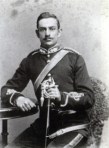
John Monash c 1888

John Monash c 1888

The uniform is similar to that worn by John Monash who was a member of the Metropolitan Brigade of the Garrison Artillery, who often trained at Queenscliff, pictured here in 1888. The artillery was later reconstructed and from July 1903, Captain Monash’s battery became No.3 Victorian Company, Australian Garrison Artillery.

Our thanks to Sgt Janner for her assistance. We will now focus on who the WO2 owner of the jacket might have been.

*UPDATE: We now know the tunic was worn by John Thomas Leyden from NSW and that the insignia indicates the rank of ‘2nd Class Master Gunner’ a highly specialised appointment with the then single grade rank of warrant officer. The second level rank of WO2 was not introduced until 1915.

We also know John Leyden was promoted to 2nd Class Master Gunner on August 1st 1909 and came to Victoria (presumably then to Portsea/Queenscliff) on May 21st 1910. He died at Queenscliff on April 4th 1916.

Our thanks to Murray Adams and Bob Bennett for the updated information.
The Figurehead

The ‘Bird Figurehead’

Sea Figurehead

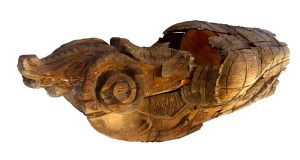
In March, a phone call from a Bob McKenzie in Geelong led to a veritable flurry of emails and meetings. He had read on our website about the figurehead and our theory regarding its origin.

Fifteen years of research into his family history and especially the Scottish couple who emigrated on the Sea in 1851, had given him drawers full of information. He had travelled to Liverpool to access relevant documents, and it was one of these, the 1847 Registration Papers for the Sea, mentioning her bird figurehead, which gave the strongest support to date to our long-held theory linking the figurehead to that vessel.

Further research continues, and may never give us 100% proof, but all evidence now points in the same direction, and is sufficient to encourage us to seek a grant for conservation work on this now very fragile artefact.

As you can imagine, when Bob suggested a commemorative event for the 160th anniversary of the wreck of the Sea at Point Nepean, we were enthusiastic.

It takes place on June 1st 2013 in our museum, with the figurehead on show, and we’ll give you an account of it next time.

Joy Kitch and Janet South

1911 In Review

1911 revealed Australia’s census to have a population of 4,435,000 people. Which bank was established? Of course it was the Commonwealth Bank of Australia. In a personality and country race, Amundsen won the victory to be the first to the South Pole and for all those wanting to hum a tune, ‘Alexander’s Rag Time Band’ was the number one hit tune of 1911.

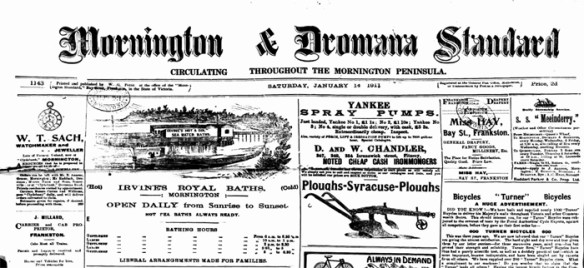
My three hours of Research at the State Library of Victoria into the events and happenings within the Sorrento community in 1911 was interesting to say the least. About ½ way through my research, I began to wonder just how many times George Morce, a local identity would be brought before the Sorrento Court. I had reached the month of August and already he had managed 4 appearances (3 for being drunk and disorderly with the usual fine of 10∕- or 48 hours’ default) and one for throwing a missile which turned out to be a beer bottle.

Mornington and Dromana Standard 1911

Here are a few further snippets of daily life in and around Sorrento in 1911 as reported in “The Mornington and Dromana Standard” of the day:

Continue reading

Sorrento Primary School Visit

4th November 2011

History came to life on 4th November in our Museum and Watts’ Cottage for Sorrento Primary School Grade 1 and 2 students thanks to a group of enthusiastic NHS volunteers in period costume.

NHS Volunteers in Costume

NHS Volunteers in Costume

From Natasha Wicks the children heard about the way of life of the Boonwurung people and lime-burning, the first local industry of white settlers. Rhonda Fitzjohn, assisted by the silent figure of Lieutenant David Collins, described the short-lived settlement at Sullivan Bay in 1803. Barry Nicholls told stirring tales of shipwrecks and rescue. Des Young’s focus on transport included the paddle-steamers that brought visitors from Melbourne and the Sorrento Tram that linked them with the Ocean Beach. Joy Kitch, attired in early motoring gear, presided over a table of mysterious household objects from days gone by which the students were able to discuss and handle. In the clothing section Jo Davie and Elaine Nicholls, splendidly dressed, demonstrated the intricacies of corsets and other relics of the past!

Continue reading