
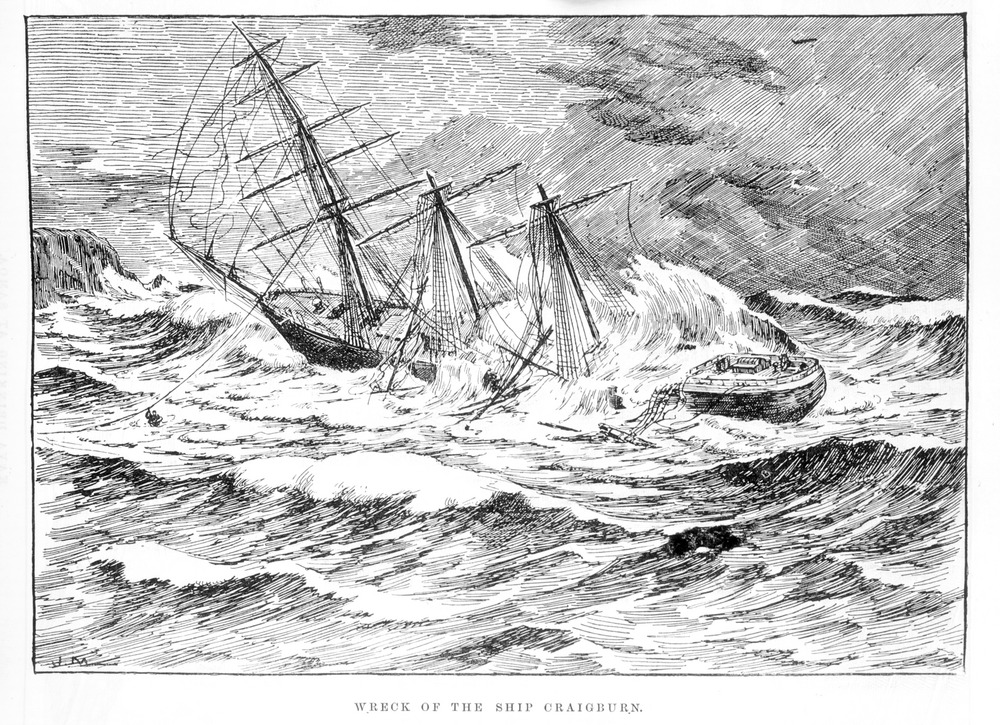
The Craigburn was a four-masted iron barque of 2,065 tons, built in 1884, on a length of 289.7 feet a breadth of 42.2 feet and a depth of 23.9 feet by W. B. Thompson, Glasgow. 1
At the time of its demise, the vessel was owned by R. Shankland & Co. and registered in Greenock, Scotland.
The Craigburn left Melbourne in ballast bound for New Zealand, with 30 crew (some sources say 29) under the command of Captain Alexander Kerr, but due to unfavourable conditions anchored inside Port Phillip Heads waiting for a moderation in the weather.
The next morning the Craigburn was towed through the Heads by the tug Rescue, with Pilot Blanchard in charge. When barely through the Heads, the hawser from the tug slipped and the barque was left helpless on a lee shore. Immediately the crew of the Craigburn made sail and endeavoured to get off the shore, but unfortunately it missed stays twice as it was relentlessly being driven towards the shore. Both anchors were dropped and held the vessel in a precarious position, approximately one mile offshore.
What transpired next led to much controversy and recrimination, and the newspapers of the day had a field day in reporting all the “facts” to their avid readers.
After the vessel was anchored the captain and pilot had a disagreement on what next should be done. With three tugs standing by, the pilot was keen to get a line aboard one of them, no matter what the cost. However Captain Ken disagreed and negotiated with the captain of the tug Eagle for a cheaper rate. But it would appear that through his frustration, the captain decided that the vessel should stay put, in the hope that it would safely ride out the storm under anchor. The pilot did not agree and began to take a hawser on board from the tug Eagle. The captain and pilot were so adamant about their respective opinions, that their disagreement came to blows, and the pilot ordered the crew to take the captain below.2
The tug then took up the tow, but due to damage to the winch the anchors could not be raised, adding to their predicament, the carpenter refused to knock out the pins holding the anchors and all on board at this time seemed to be mayhem. Eventually the tug took up the strain breaking the grip of the anchors on the bottom, but right at the most critical time the hawser parted and the Craigburn was once more at the mercy of the elements. This time the grip of the anchors was not so secure and the stricken vessel began to slowly drift shorewards.
Due to darkness coming on, no tug could get near enough to the vessel to get another line aboard, so they stood out to sea and hove-to, to await the dawn.
During the night the pilot decided that they should abandon the ship while there was still hope, and so the crew were divided into the two ship’s boats. The first under Pilot Blanchard left the vessel immediately with 13 crew and after a few narrow escapes got to seaward and relative safety where a miserable night was spent on a stormy sea until picked up next morning in the Rip by the tug Eagle.
Two hours after the first boat got away, the second ship’s boat left but was not so lucky, for on launching it was immediately struck by a series of huge seas which all but destroyed it. The crew were left to struggle in the turbulent seas, trying to make the shore the best way they could, unfortunately five of the crew did not reach the shore alive.
It was then realised from the observers on shore, that some crew were still on board the Craigburn, which had by then been forced by the huge seas into the breakers and was bumping heavily. In a very short time the vessel lay broadside on to the sea and the four hapless mariners who were left on board had to begin their fight for life.
During the night the lifeboat crew had managed to drag the rocket apparatus across from Sorrento and set it up at dawn the next day. Luckily, on the second shot a line was fired across the bows of the Craigburn, which eventually was secured on to the foremast by the captain and carpenter. A breeches buoy was set up and the carpenter was the first man to make the shore in safety.
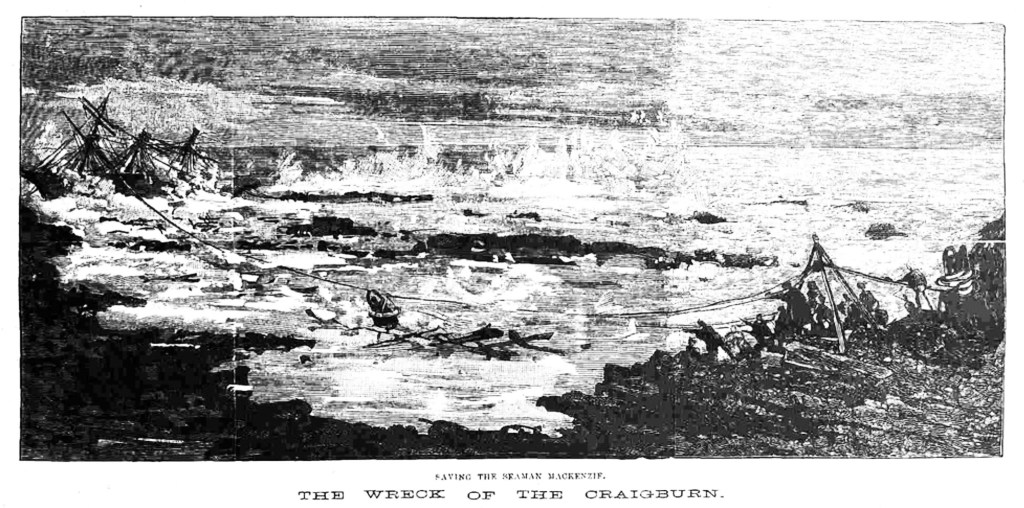
Of the three remaining on board the stricken vessel, the first mate was intoxicated and refused to leave the vessel, a seaman named John MacKenzie vowed to save him, so the captain was the next to leave the vessel and gained the shore in a state of exhaustion. John Mackenzie finally gave up on trying to help the first mate, leaving him sheltering on the forecastle and began to prepare for his own rescue.
However, the lifeline had snapped so the breeches buoy was no longer an option for his rescue, but the light line to the shore was still intact, so MacKenzie tied himself to it and jumped into the water, being hauled ashore by the rescuers on land. The first mate in a last desperate effort for survival jumped into the water to try to swim ashore, but did not get very far before disappearing in the turbulent seas.
The sequel to the disaster became one of claim and counter claim through the media, with the truth being so clouded by innuendo and sensationalism, that it is hard to find out what really transpired with the loss of the Craigburn.
At the subsequent Marine Inquiry it was found that Captain Kerr was guilty of drunkenness and neglect of duty in not accepting the tow of the tug. He was consequently ordered to pay 50 pounds costs and his certificate was cancelled. However, it is questionable whether this had any effect as the captain had already left the colony.
The remains of the Craigburn were positively identified by Man Farman and Cordon Baker when clearing a cray pot for a local fisherman in the early 1970’s. They discovered upon reaching the bottom that the cray pot was entangled in the iron of the hull and on further exploration they discovered and successfully raised the intact bell bearing the name Craigburn. Another more ornate bell was also raised at the time by another local diver, Colin Ferrier.
Go To Shipwrecks Homepage HERE
 Nepean Historical Society