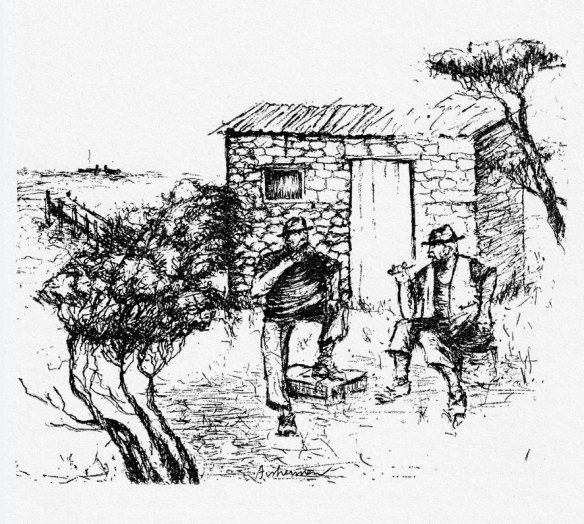
p 90
. . . coastal defence emplacements set up at Point Nepean and Portsea by Captain Scratchley, R.E., an officer sent out by the Imperial Government . . .
The development of the forts at Point Nepean is covered in this website under “Defence” HERE
p91
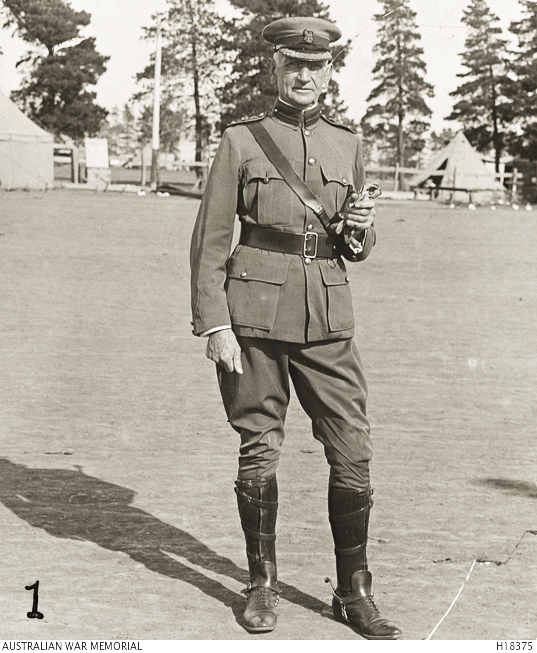
. . . headed by the magnificent Colonel Stanley on his charger . . .
John Stanley (1851 -1935) Born in Lancashire, England, we are not sure when John Stanley came to Victoria, but we do know he joined the Victorian Permanent Artillery from 1874 – 1979. During this time he worked on the defence works at Queenscliff. Returning in 1884, he was promoted to Major in command of the North Melbourne Battery in 1889. In November 1891 he was appointed to a staff position with the Militia Garrison Artillery.
In March 1900 he became Lieutenant Colonel in the Permanent Forces, and Commanding Officer of the Royal Australian Artillery in Victoria, based in Queenscliff. This included the garrisons at Queenscliff, Point Nepean and Point Franklin in Portsea. 1
It is in this capacity that he attended the Wreck of the Sierra Nevada at Portsea. (see below)
By 1906, now Colonel Stanley was military commandant for Victoria, retiring in 1912. During the war he came out of retirement to become Quarter-master General of Australia and was promoted to Brigadier-General. He was awarded the C.M.G. on 24 Jan 1917 and promoted to Major-General.
After a long period of ill health John Stanley died in Melbourne in 1935.
Bombo
. . . The most handsome soldier, a well-proportioned six-foot two gunner known as ‘Bombo’, fascinated Davo and Jimmy . . .
We know very little about Gunner Frederick Benbow, except that he was certainly injured in the accident at Queenscliff. 2
The only Military Records we were able to find indicated that Frederick was born in Manchester in about 1860. He had only recently ‘re-engaged’ for a five year term with the Victorian artillery Corps, Queenscliff in October 1890. He had previously joined in October 1885.
Contrary to our character’s claims, Frederick Benbow was only 5′ 8″ !
We have nothing on Frederick Benbow’s father.
. . . he transferred in exchange for a thirty-acre block at the Heads (originally issued to D. Swan) which was inherited by his handsome son. . . .
We have no record of any Benbow in the Rates records.
The only block that was ‘originally issued to David Swan‘ was Crown Allotment 67 (35 acres & 29 perches) which he bought for £36 in July 1877. The allotment was mortgaged to Lime Merchant William Allison Blair. It was transferred to Blair in 1888.
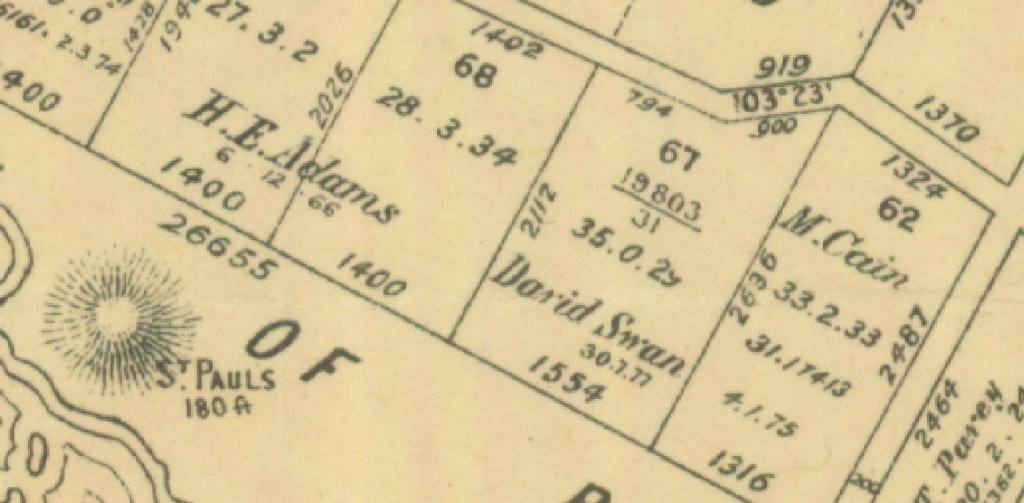
This is South of Melbourne Rd just to the west of Hughes Rd
It is worth noting that it was part of this Crown Allotment that Victor Keating bought in 1928 and built what would become known locally as “The Spanish Mission”.
p93
. . . tomorrow we’re creepin’ over to Silver Johnny’s poultry yard behind the pub and grabbin’ a couple o’ young turkeys out of the bis flock roostin’ there. He won’t miss ‘em; and this is a special occasion!” . . .
As mentioned previously John Cain jp, “Silver Johnny” was the licensee of the Nepean Hotel at Portsea from January 1898. His daughters took over after his death in 1920.
p96
. . . Wasn’t there a riot during a race meeting on the big scrub paddock yonder a while back? It seems that you two played a leading part in a scheme that was against the rules.” . . .
Portsea Amateur Racing Club
From 1897 to 1902 the Portsea Amateur Racing Club held an annual race meeting on the block between the Nepean Hotel and Back Beach Road. Known as Cain’s Paddock. For the first two years the event was held on the Queen’s Birthday in May, and thereafter was on ‘Anniversary Day’ on January 26th.
The entries were almost entirely from local breeders.
We’ve not been able to find any reference to “Rufus”!
p99
. . . In the spring of 1887 a small passenger steamer, the Cheviot, lost her propeller and crashed on the rocks near Portsea ocean beach, resulting in the loss of thirty-five lives. . . .
The Cheviot
The story of the Cheviot is told on this website HERE
. . . the drowning of the skipper and a deckhand of the schooner Nowra . . .
Nowra
The story of the Nowra is told on this website HERE
. . . the wreck of the iron ship, Sierra Nevada, from Liverpool, also at Portsea ocean beach . . .
Sierra Nevada
The story of the Sierra Nevada is told on this website HERE
. . . This spiritous traffic was eventually checked when a guard from the military barracks was posted on the beach; . . .
As was reported in the Argus at the time, this was Lieutenant Colonel Stanley and his men. 3
p100
. . . a young lad, known as Sandy Mac, as driver, having first gained approval from
the schoolmaster . . .
Pure speculation, but the only likely child at the Sorrento School at the time was Charles Mackinnon (1889 – 1969), who was in his final year. 4
p101
. . . “Sure, we’ll drink the ‘ealth of detective Crissy — that’s ‘is name so they told me in the township,” . . .
Detective Inspector John Mitchell Christie (1845 – 1927) of the Customs Department was lead investigator and prosecutor at the time.

Inspector Christie was an interesting character, writing a book about his adventures soon after his retirement in 1910. As well as chasing smugglers, he was a royal bodyguard on a number of State Visits to Victoria. 5
. . . butcher Jack Skullon was pulled up close to the wreck early one mornin’ by Crissy . . .
John Alfred “Jack” Skillen (1868 -1924) was born in Daylesford. His father James was a grocer. By the early 1890s he was an employee of Mornington butcher J.S. Adams. Soon afterwards he opened a butchers in Sorrento. 6
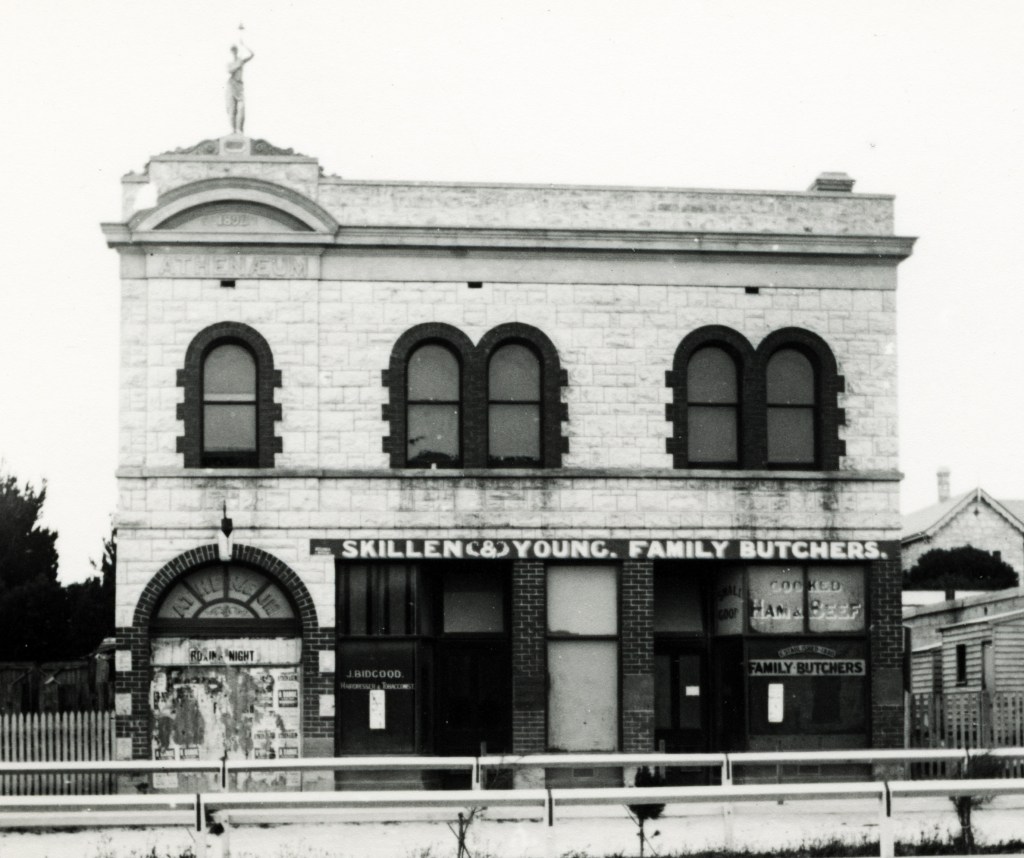
In 1895 Jack married Charlotte Young (1869 – 1966) from Dromana. This shop in the Athenaeum was in partnership with Charlotte’s brother Edward Young (1866 – 1931).
This partnership was dissolved in September 1900.
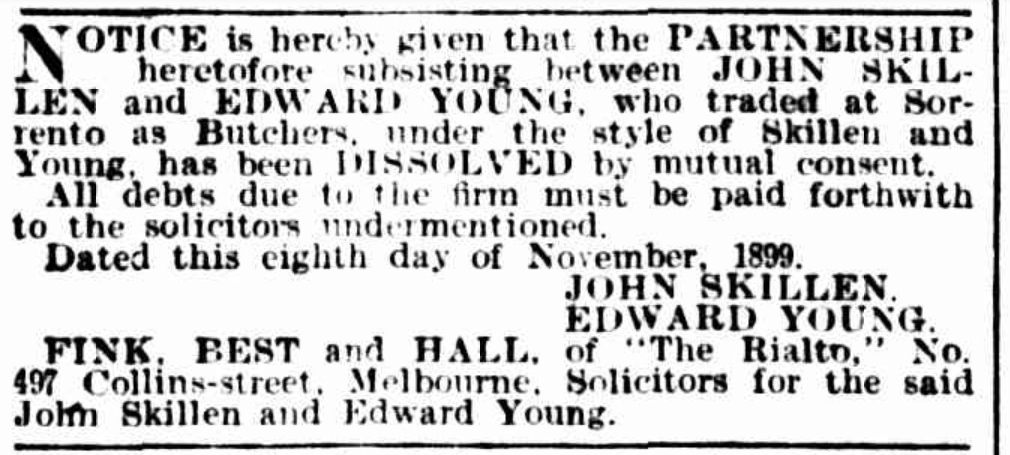
The Skillens moved to Shoreham, but delivered meat and smallgoods all over the Southern Peninsula. Both Charlotte and their son Edward drove carts from Balnarring to Sorrento.
The story of the Sierra Nevada grog in Jack’s cart also appears in “The Butcher, The Baker, The . . .”. So it appears to be a commonly known tale.
Edward Skillen would go on to operate in Flinders, eventually passing the business on to his nephews Max, Ted and Bert Cairns in 1973. One of their drivers was Eric Lucas, the source of the ‘grog in the cart’ story. 7
- The Herald 27 Sep 1911 p8 from Trove HERE ↩︎
- The Argus 30 Mar 1891 from Trove HERE ↩︎
- The Argus 15 May 1900 from Trove HERE ↩︎
- Sorrento School Register 1893 -1913 in NHS Collection ↩︎
- Australian Dictionary of Biography HERE ↩︎
- The Butcher, The Baker, the . . . p40 by Bruce Bennett 2008 ↩︎
- Idid. p76 ↩︎
Return to the On The Rocks – Homepage HERE
 Nepean Historical Society