p 54
Pious Pete
. . . Peters (known locally as Pious Pete) returned to Rye . . .
As mentioned, when we first meet Peters in Chapter 3, we know nothing about this character.
. . . the owner of the station had asked Tommy what his full name was, and he had replied, “Thomas Buffo”. . .
In this chapter we hear a lot more about the life of Tommy. Despite this we still have no idea if he is based on a genuine character.
Some might speculate that, given his literary bent, Tommy is a caricature of Victor himself.
p57
Lottie’s Parentage
. . . His mother (Lottie) was the daughter of an Englishwoman married to a man named Ah Fee from Canton . . .
Here we get a clue to a historical basis for the Lottie character . . .
Charles Ah Foo (1833 -1887) came from Canton, China and was a market gardener in Sorrento. He leased 4 acres from The Ocean Amphitheatre Company from 1878 and later George Coppin in what is now the Morce Avenue car park. He married Mary Stewart the daughter of a Commissioning Agent from Collingwood in 1880.
They had a daughter, Georgina born in 1880 who died in infancy
Charles died in May 1887 after falling on the path at London Bridge. He is buried in Sorrento Cemetery. His death certificate describes him as a Quarryman, so he may also have worked with the Limeburners.
Clearly the dates of Charles Ah Foo don’t correlate to those in the book. But does this matter?
p61
The Steamers
. . . After a long passage from England the paddle-steamer Lonsdale arrived, in 1883, to enter the bay excursion service. . . .
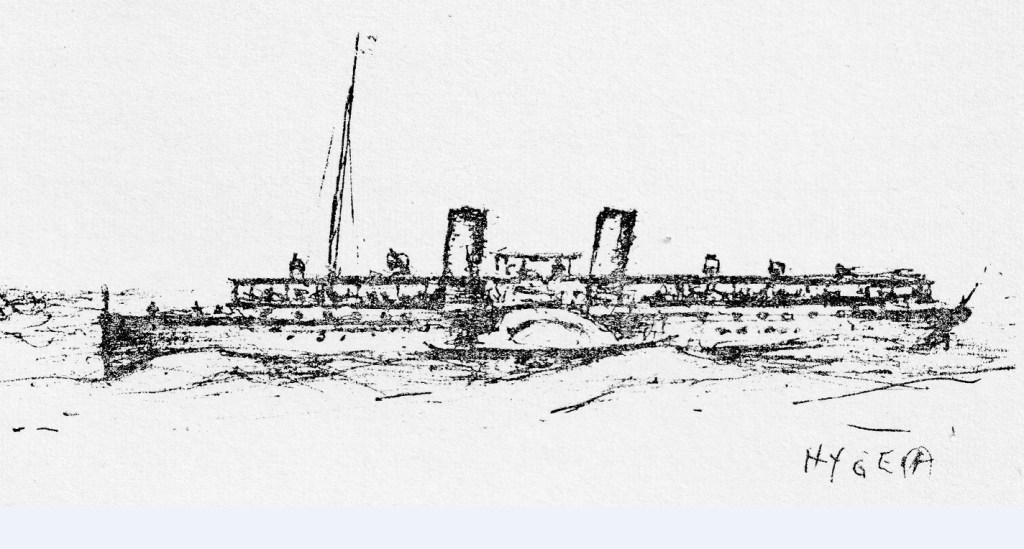
Here we get a series on the history of some of the Paddle Steamers that serviced Sorrento and Queenscliff. We will cover this topic in more detail at a later date.
p62
“Darky” Joe Fogue
. . . “Darky” Joe Fogue offered fresh boiled crayfish priced at sixpence to a shilling (extra large) and rewarded each customer with his familiar broad smile. . . .
While this is the second time we hear of Joe Fogue, we learn more about him in this passage. He becomes a regular character throughout the story. Principally as transport for the central characters.
Joseph Oliver (b. 1859) aka “Black Joe” was another real character from “Canvas Town” on the corner of Melbourne and Canterbury Jetty Roads.
In his 1966 talk to the NHS, Jack Ritchie related the following:
“He is described as a big wild man, very dark skinned, from Terra del Fuego off the southern tip of South America. He lived with a young girl said to have been his wife (?), and existed mainly by fishing off the rocks. He is said to have been a particularly successful crayfisherman and he supplied the Sorrento hotels. Mr. Barney Cain remembers him grinding his own flour in a stone pestle and mortar.” 1
Further research informs us that Joe was actually from Cape Verde, a Portuguese colony 620km off the West coast of Africa. There were a number of Cape Verde Islanders at ‘The Heads’ working in various limestone quarries and kilns. Others of these were Peter Thompson (1823 -1871) from Santiago Island and Antonie Salvas from Braos. The Cape Verde Islanders married locals and became multi generational members of the community.
The ‘young girl’ Joe is said to have lived with was actually the granddaughter of Peter Thompson, Lavinia Eva Thompson (1893 -1938).
The primary sources we have for Joe Oliver relate mostly to his being charged in May 1908 at the Sorrento Court of Petty Sessions with “Unlawfully and carnally knowing a girl named Lavinia Eva Thompson under the age of sixteen years”. He was remanded to appear at the Criminal Court, Melbourne where he was convicted and later sentenced to six months hard labour. Details of the trial can be found on Trove HERE and HERE.
Note that one of the witnesses was James Relph (sic).
It was noticeable that in the trial, Oliver could not speak English and had a Portuguese translator.
“Butty” Marsden
. . . But the most picturesque vendor (remembered as “Butty” Marsden) confined his perambulating trade to smokes . . .
Ralph Marsden (1857 -1937) born in Over Darwen, Lancashire. Married Sarah Ann Isherwood (1858 -1935) in Blackburn, Lancashire in 1882. We don’t know when he came to Australia, but we first find him at Sorrento when in June 1893 he wins a Defence contract to supply rations to Fort Franklin for 8 1/2d per ration. His address is given as “Post Office, Sorrento”.
In July 1894 David Cousins applies for the transfer of his ‘Grocery License’ to Ralph. It is for a premises at Amphitheatre Rd. Sorrento. David Cousins’ store was next to the Oriental Palace before it ‘expanded’ two further arches Southward.
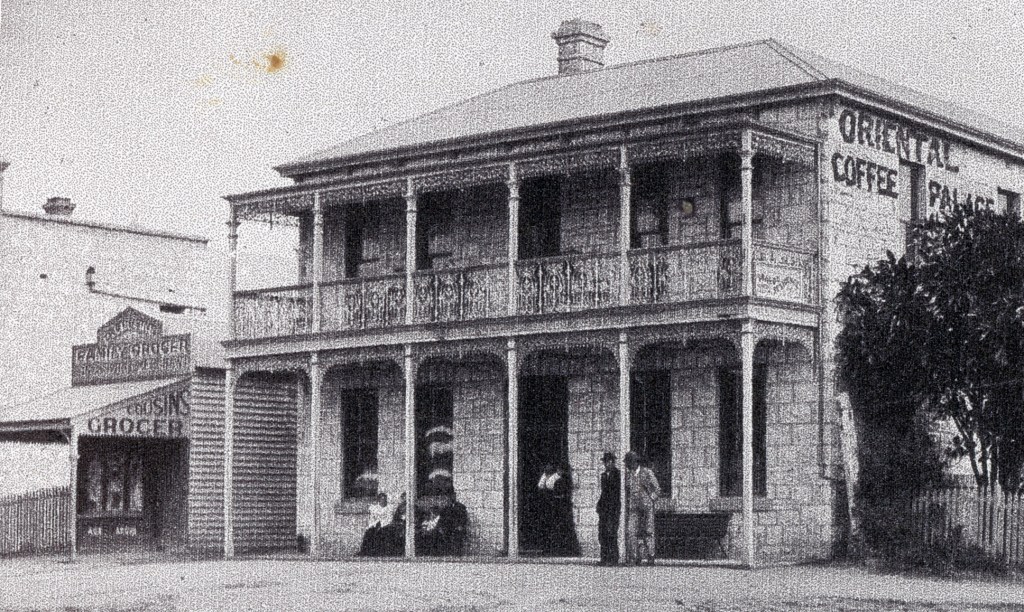
Possibly not satisfied with leasing from William Hughes, in September 1895 Ralph buys what is now #4 Ocean Beach Rd. (the left hand side of Stringers). Here he adds a story to the original brick building on the block.
In 1902 Ralph buys the block on the corner of Point Nepean Rd. (opposite the Koonya). There he builds a ‘Tea Rooms’ which is run by his Sister in law, Elizabeth Isherwood (1861 -1944).
p63
. . . In a large shed at the rear of the shop Butty conducted a Palais de Danse . . .
What we understand as the Palais de Danse was built some years later when J.J. Kiel bought both the Tea-Rooms and the block next door. It is not certain where Marsden’s Palais de Danse might have been.
p64
Alfie
. . . Overhearing these remarks was a tall, neat young man twirling his black moustache. He was known to Davo as Alfie, son of the part-owner of a Melbourne newspaper and a frequent customer at the bar. . . .
Here we meet Alfie for the first time. He will become a central character in the book and towards the end could perhaps be regarded as a ‘narrator’. Despite many clues dotted throughout the book we are unable to determine who he might be based on.
. . . our holiday house which you fellows helped to build. When the house was finished
father was in the process of writing out a list of extra furniture for it when he dropped his pen, and leaning over to pick it up had a heart seizure and died.” . . .
p67
The Hotels
. . . “Excuse me, old chap, I’m on a holiday here and my curiosity is aroused regarding the people engaged in managing the large residential hotels here since their inception. If you
three would join me in a drink I’d appreciate hearing anything you could tell, if you’re inclined to favour me.” . . .
Here we begin a device for Victor to detail the early history of the various Hotels.
As it probably warrants a book on its own, we will elaborate on this when time permits.
p68
Ike Bensilum
. . . Ike Bensilum switches from the Sorrento to the Continental. Ike is a good-lookin’ dandy and has polished up the Continental . . .
While this is the second mention of Isaac Bensilum (1858 -1930), it is the most descriptive.
Isaac was born in London, the son of a Gibraltar born merchant Joseph Bensilum and Maltese Esther Correa. After attending Norwich College, he seemed destined for a life in medicine, but after a period at London University he diverted to accounting. 2
He came to Victoria in about 1877, traveling and working around the various colonies. After managing the Port Phillip Club Hotel for two years he took up management of the Sorrento Hotel. As stated, he switched to the Continental in 1890 having bought it from George Coppin.
p71
. . . A few years after this interchange of script Ike built in limestone the Athenaeum, a handsome theatre with large stage and dressing rooms, and patrons had the pleasure
of seeing actor Coppin perform on its stage on two or three occasions for the benefit of charity. So ended the battle of the beaches! . . .
In 1893 Isaac buys the block of land to the South of The Oriental Palace and builds a ‘dance hall’. The Athenaeum, which he runs having transferred the licence of the Continental to his wife Nellie in August 1893. The Athenaeum is sold in 1899.
Isaac served as a Shire Councillor for the West Riding from 1893 to 1895.
After he sold the Continental in 1913 Isaac moved to St Kilda. He maintained his interest in Sorrento through his 1903 purchase of a significant stake in the Sorrento Tram Company. He held this until its closure in 1921. He lived in St. Kilda until his death in 1930.
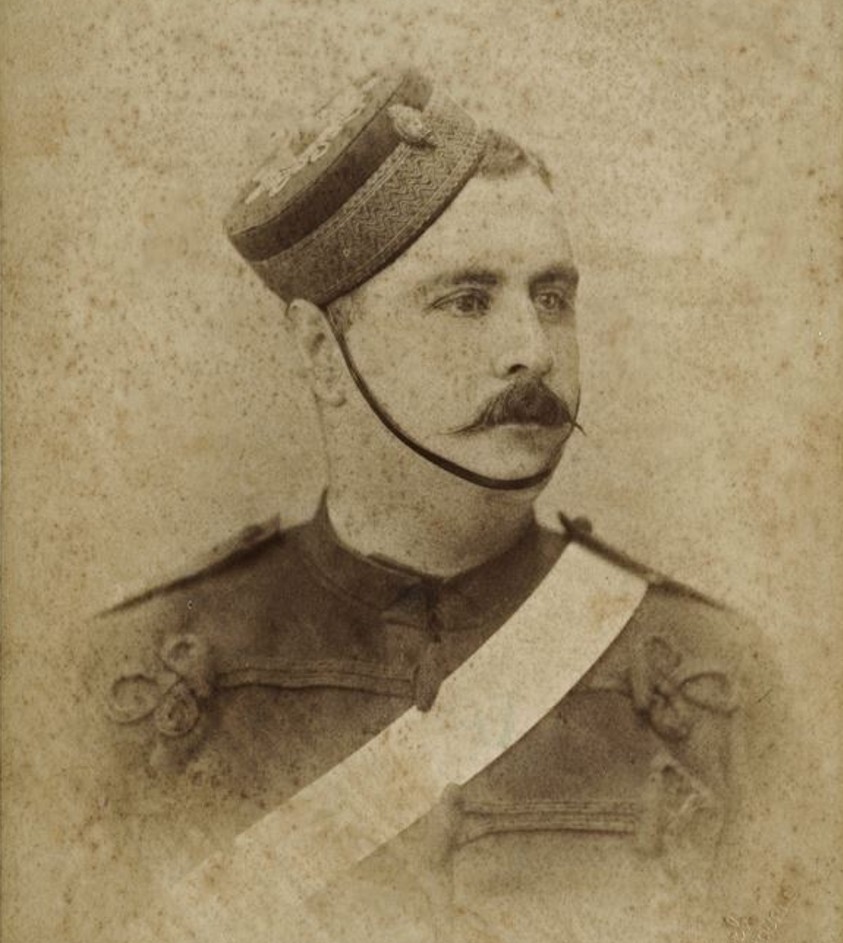
The only picture we have of Isaac Bensilum if of him in his uniform in the Victorian Militia. He was appointed a Lieutenant in June 1890. We have no record of him serving in any other forces.
- From a talk “Blairgowrie (Koonya to the Divide)” given to the NHS by John Gowar “Jack” Ritchie (1915 -1992) on 2nd Sept 1966. Transcript in NHS Collection ↩︎
- “Life Portraits”, Mornington Standard 3 Aug 1893 p1 from Trove HERE ↩︎
Return to the On The Rocks – Homepage HERE
 Nepean Historical Society