
p 13
. . . the camp had removed to another kiln on the more placid Port Phillip bayside, . .
There were kilns all over the area primarily from what became the Quarantine Station to a large number around Rye.
. . . Lugger Jack’s schooner . . .
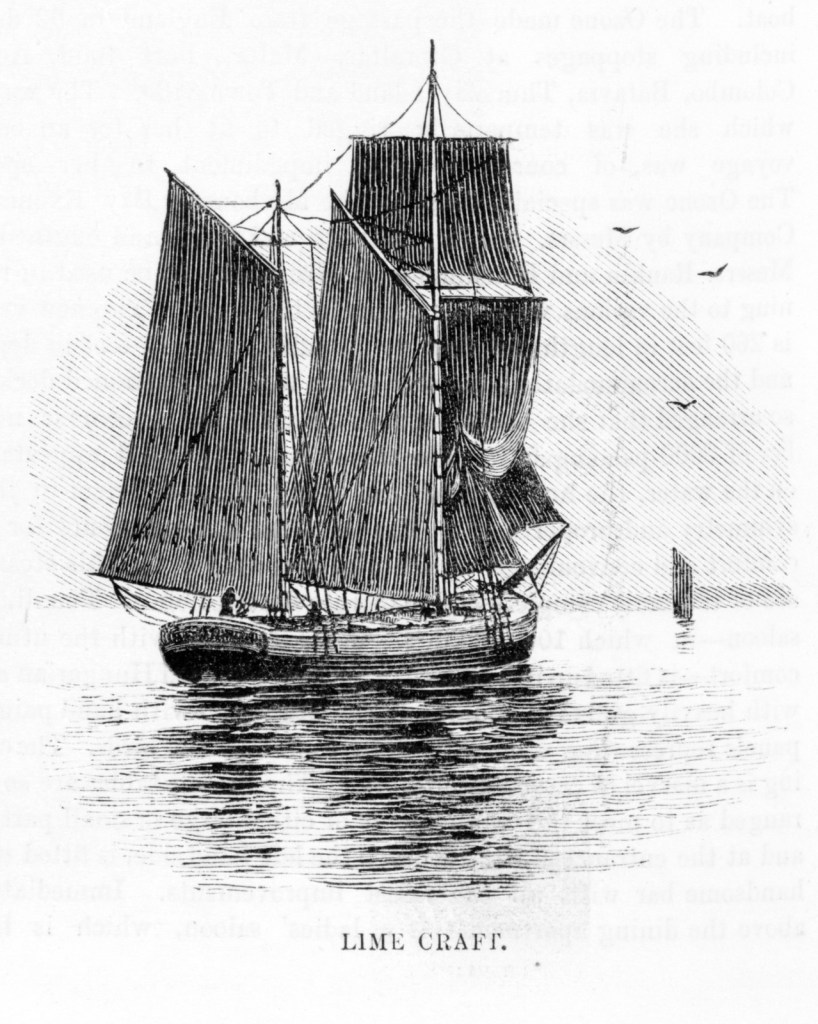
Lugger Jack was the nickname of John Boswell Clark (1833 -1901). Clark was a mariner originally from Aberdeen. He spent his early years at Port Phillip skippering a lime craft. Later he would retire from the sea to become a publican. In 1859 he married Ted the Fiddler’s eldest daughter Mary Ann Skelton.
Of special note to us, he was the Author’s grandfather.
. . . met among ‘em this parliament man named Charlie Duffy . . .
Sir Charles Gavan Duffy (1816 -1903) was an Irish radical, writer and politician. He came to Melbourne in 1856 and immediately entered the ‘New’ Victorian Parliament. Most importantly he was a significant investor in the area in the 1860s and in late 1869 would name Sorrento.
p14
. . .wife of Ted the Fiddler . . .
Edward Skelton married Harriet Dickens in Richmond in 1840. When they moved to the area with their first surviving child, Harriet would become the unofficial midwife to the district.
Edward Skelton jr “Ted” (1853 -1901) was the Skelton’s sixth child and third surviving son.
p15
. . . Great changes were about to take place in the district during the mid-sixties. . . .
After the Land Act of 1860 enabled the sale of smaller parcels of Crown Land outside the central districts the area was surveyed and sold off at regular auctions held in Melbourne.
James Sandle Ford bought the first Crown Allotment offered in the Parish of Nepean, County of Mornington, (CA 29 of 160 acres) in March of 1860.
Charles Gavan Duffy would follow in 1863 buying several Allotments that covered much of the area from the West of Hotham Road to what is now Campbell’s road.
. . . George Coppin, the well-known theatrical performer and entrepreneur . . .
George Selth Coppin (1819 -1906) was certainly an early promoter of Sorrento, but would not arrive until about 1874.
There was certainly plenty going on by 1870.
p16
“Duffy’s Point”
Now known as Point McArthur or Nylands at the western end of Point King Beach. This was the original ten acre home property of Charles Gavan Duffy. He built a modest home here which he escaped to regularly as a refuge from Melbourne.
p19
. . . a paddle steamer went aground near where we worked at Point King. It had aboard about a dozen or so politicians and big toffs headed by actor Coppin . . .
This is an oft repeated story that appears to have its origins in the ‘Coppin Story’. There is, however nothing to support the story.
. . . Only an entrepreneur like Coppin, whose record reveals him as opulent today and broke tomorrow, would sedulously embark on a spectacular gamble such as building up a fabulous show place. . .
This is probably a more accurate assessment of George Coppin’s financial contribution to Sorrento.
p20
. . . Duffy intends to name the new centre ‘Sorrento’. . .
This is certainly correct, although there is no evidence he gave away five acres to build a hotel. (Presumably the Sorrento Hotel). Duffy never owned the land the hotel now sits on.
. . . John Campbell’s shanty had now become respectably licensed . . .
The first hotel in Rye was initially known as the ‘Tootgarook Hotel’. The first licence was awarded to William Cottier (1821 -1888) in June 1867. The building was on a town allotment (just east of Napier St.) owned by John Campbell (1830-1907) who won the tender to build the Rye pier in 1867. Campbell and Cottier were partners until 1870, when Cottier became insolvent. In December of 1870 John Campbell changed the name to the Rye Hotel.
p21
. . . Early in December, 1862 a meeting of landowners held at the house of Robert Cairns of Rosebud, Parish of Wannanue . . .
The Kangerong Roads Board was indeed formed at this meeting. Robert Cairns (1816 – 1884) from Scotland in 1852 and along with his siblings was a pioneer of the Boneo area1.
Roads Boards were landowner sponsored groups that raised funds, as the name suggests, to build and maintain roads in the area.
p23
. . . that stranger known as Snakey . . .
We have no idea who this might refer to, but it’s a great story!
. . . Charlie Spiers, skipper of a limecraft . . .
Charlie Spiers was indeed the skipper of “Unity” a 28 ton lime schooner built in 1867 that operated from 1870 to October 1887. It was owned by Melbourne Lime Merchant Charles Campbell from 1875-77. Campbell is best known to us for Campbell’s Road.
Return to the On The Rocks – Homepage HERE
 Nepean Historical Society