p1
. . . Buff was one of the latter group. His name was said to be Buffleou, bestowed
on him by a French father and Scots mother. To his mates the name sounded
like Buffalo — hence it became “Buff ”.
Given that Buff had “written articles for Melbourne newspapers” and Victor’s activity with the local paper is there an element of autobiography in the character?
p2 – The Limeburners
. . . Bill Davis . . . Davo . . . Davo’s North Country dialect, pitched high in the tonal scale . . . – no other knowledge
. . .The ocean shore is only a few yards away . . .
Would indicate the camp is south of Melbourne Rd. The best known of these was near the corner of Canterbury Jetty Road. By the 1880s this was known as “Canvas Town”. 1
p4
Jimmy Relph . . . Ginger-headed Jimmy Relph, a Cockney, to whom all situations seemed
cause for merriment. . . .
James Ralph (1833 -1911) was a genuine character at Canvas Town in the 1880s.
Jim Ralph had a hut just south-east of the Canterbury Jetty Road-Old Melbourne
Road junction. 2
Born at Uffington, Berkshire in 1833 James had worked as an agricultural labourer, until joining the 57th Foot Regiment of the British Army (known as “The Die-Hards”) in about 1860. The 57th served in the Maori Wars from 1861-1867. Upon return to England he was discharged on 3rd July 1874. We don’t know exactly when or why he came to Australia, but it appears he was on the Peninsula by the 1880s. He lived in Rye until his death there in August 1911. He never married.
Clearly James Ralph’s timeline does not quite fit some of the book, but here we might grant Victor some creative licence.
Ned Gillot – no knowledge (at this stage)
Tom Bennett – this is the only mention of this character in the book.
Jimmyuse – James Hughes – There was certainly a James Hughes (1838 -1866) at The Heads. He was the son of a well known limeburner William Hughes (after whom Hughes Road is named). The Hughes family were from County Antrim, Ireland.
p5
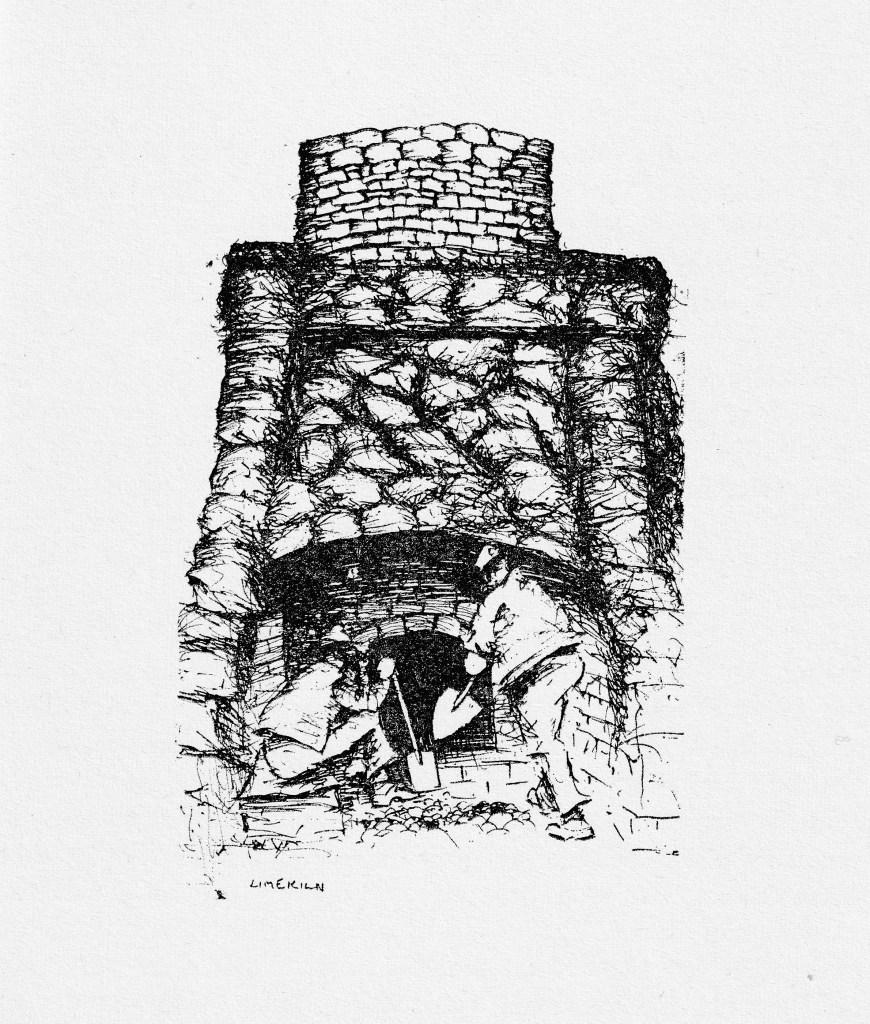
The camp layout . . .
While the kiln only formed part of the camp, there is an excellent model of a lime kiln at the Sorrento Museum and also a full scale replica on the foreshore at Rye.
p6
There were a number of Maori fishermen at The Heads.
p7
. . . inspired him to look forward to a lively drinking session at the village shanty where, he had been informed, the scattered community congregated in between working periods. This rendezvous was on the bay side of the peninsula about two miles from the camp . . .
This is possibly the precursor to the first Rye Hotel.
p8
Monty from California – no knowledge
p9
Ted the Fiddler – Edward Skelton (1809 -1859), one of the area’s early pioneers. He was an early limeburner who would eventually have a kiln at what is now Shelley Beach..
. . . farmer Ford . . .
This is James Sandle Ford (1811-1890), a former convict, farmer, limeburner and pioneer of Portsea.
p12
. . . his pupil known as Lottie, a honey-coloured maiden of part Chinese descent, . . .
Here we meet Lottie for the first time. There were a significant number of Chinese workers at The Heads at the time, with many working on the kilns and others as market gardeners.
- From a talk “Blairgowrie (Koonya to the Divide)” given to the NHS by John Gowar “Jack” Ritchie (1915 -1992) on 2nd Sept 1966. Transcript in NHS Collection ↩︎
- Ibid. ↩︎
Return to the On The Rocks – Homepage HERE
 Nepean Historical Society